





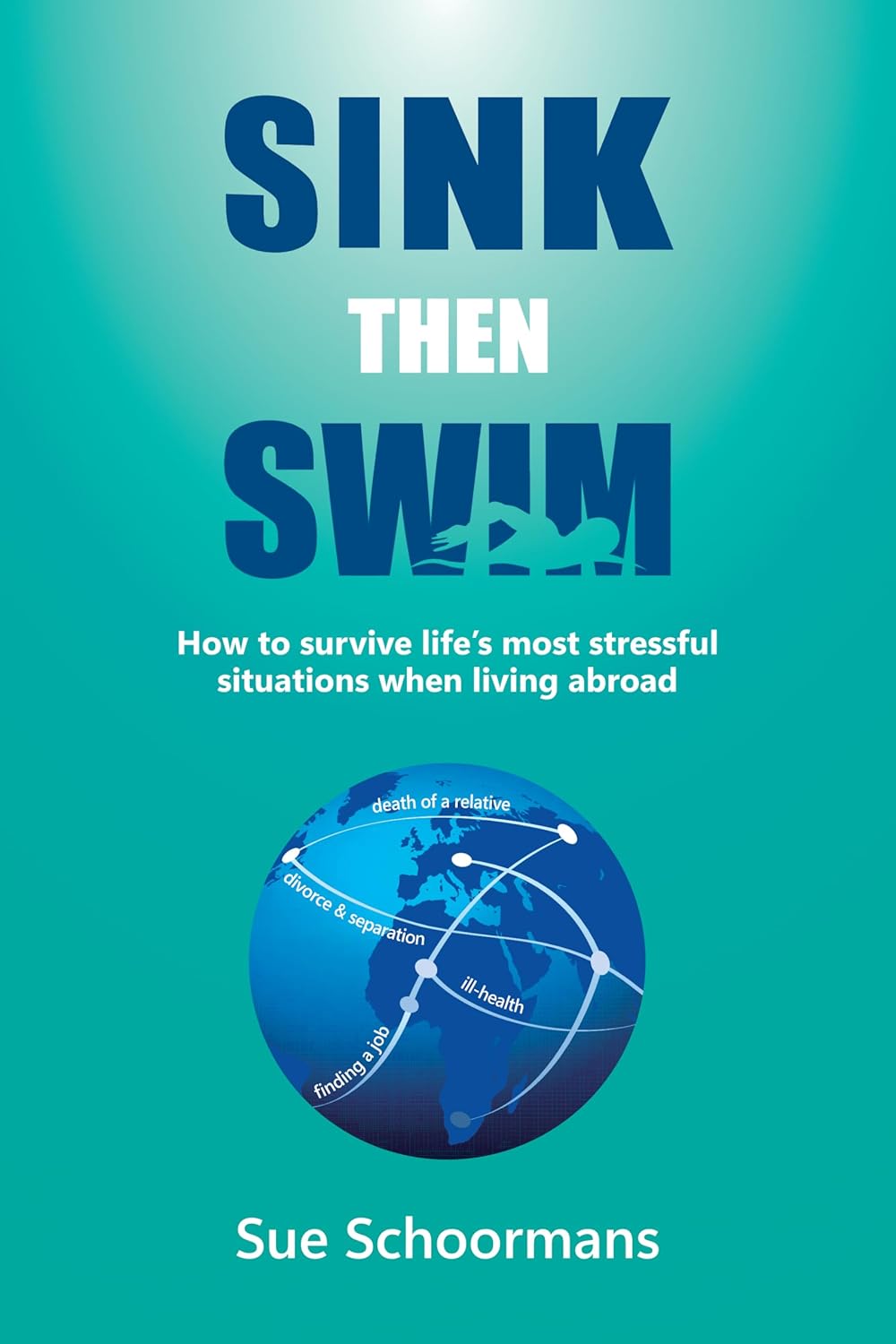
Sink Then Swim: A Book I Love (and Here’s Why)
When Sue Schoormans invited me to write the foreword for Sink Then Swim: How to Survive Life’s Most Stressful Situations When Living Abroad, I felt deeply honoured. As someone who has spent many years supporting expats and globally mobile individuals through Expat Nest, I immediately recognised how valuable this book could be for people navigating the complexities of life abroad.
Living internationally can be deeply enriching, but it can also bring emotional, practical and psychological challenges that are often difficult to speak about openly. Alongside the excitement and opportunity, there may also be uncertainty, grief, loneliness, identity shifts, relationship strain, illness, or moments where life simply feels overwhelming.
This is exactly why Sink Then Swim feels so important.
Writing from the heart and drawing on a lifetime of experience, Sue has created something truly special: not just a book, but a guide, a companion, and a source of comfort for anyone navigating life abroad.
Drawing on over 20 years of international living, Sue combines real-life stories, practical tools, personal reflection and grounded insight to support readers through some of life’s most difficult moments – including loss, divorce, separation, ill-health, career transitions and major life change.
One of the things I appreciate most about this book is its honesty.
Sue doesn’t shy away from the realities of expat life. Instead, she meets them with empathy, courage and wisdom. I was especially moved by the inclusion of personal stories and the voices of others living abroad. These narratives offer comfort, perspective and reassurance that we are not alone in what we experience.
Reading Sue’s own timeline of significant life events deeply touched me. There is a rare openness and vulnerability in the way she shares her story.
I also deeply appreciated the balance throughout the book between emotional reflection and practical guidance. Sue explores concepts like self-leadership, values and strengths not as abstract ideas, but as essential lifelines during periods of uncertainty and change. Each chapter offers thoughtful exercises and “swimming lessons” that help readers gently find their footing again.
At Expat Nest, I often see how important it is to have the right support during times of transition. Sink Then Swim offers exactly that: a compassionate and deeply human resource that readers can return to when life abroad feels difficult or disorientating. As Sue writes: “You can and will survive life’s most stressful situations when living abroad… knowing that first you sink and then you swim.”
This book gave me food for thought, taught me a great deal, and most importantly, made me feel less alone. I recommend it to anyone living an international life – whether you are just beginning your journey abroad or already deep in the waves.
What resources have you found essential to navigating your life abroad? The Expat Nest community would love to hear about it!
Hi Vivian,
I think « Sink and next swim” is perhaps a tad too strong. I would rather say “May sink and next you likely will swim”. Because even in our home countries one may face ample challenges. Ran into two last week f.i. And whilst in general civil services at the municipality of The Hague has been helpful and swift, I also have two outstanding questions for quite some time now. On a positive note though, the civil services at the municipalities of Sluis and Terneuzen were reponding almost by return. I may add that thanks to FB and of course the internet in general one can find easily help but also prepare oneself well in advance.
Further to my road warrior days, I remember also that one who travels abroad, whether on business or private, should read up in advance. Even if one speaks the language. To take but an example, in our tiny The Netherlands not even the metropole area is homogenous. Ample difference between habits and way of speak in Amsterdam/The Hague/Utrecht/Rotterdam. Let alone the cities in het Groene Hart. I can go on and on and on, but I know you got the jest.
I also keep in mind that many people struggle to thread out of their comfort zone. I am like Dr Jekyll and Mr Hyde here. Some days I dread to do so and other days I swell in happiness doing so. Like yesterday at the hospital, a new cast for our daughter as she had pulled the old one off, and I was having fun with two elderly ladies because our daughter was throwing a tantrum in the waiting room. I used that to connect with said ladies. But also liaised with the orthopaedic consultant and the previous day, when I went to the ER to have the cast redone if only temporarily since our little tiger runs around all day and often falls as her feet can’t follow the rest of the body, the two nurses who applied a new cast and I had good fun as our daughter was grabbing for the necklace but also face and ears of one of the two nurses. Back to subject, many who move abroad never really move out of their comfort zone. Don’t join a group of locals etc. If they need a tradesman, they will look for one who is from their home country.
All the aforementioned said, it is though good that there are people like you. Because the bucket can overflow. Too many changes at once. And for women this probably is even more challenging. Having to take care of a family and/or pregnancy etc. etc.
Warmest, Louis
Hi Louis
Thank you so much for reading the article and for taking the time to share your thoughts and experiences. You make a good point that settling into life abroad is rarely a simple “sink or swim” situation – even in our home countries, navigating systems, communities and everyday life can come with its own challenges.
I really appreciate your reflections on stepping outside one’s comfort zone and the value of connecting with local communities. Building those connections can make such a difference when adjusting to a new place.
Wishing you all the very best, and thank you again for joining the conversation.
Regards
Vivian